
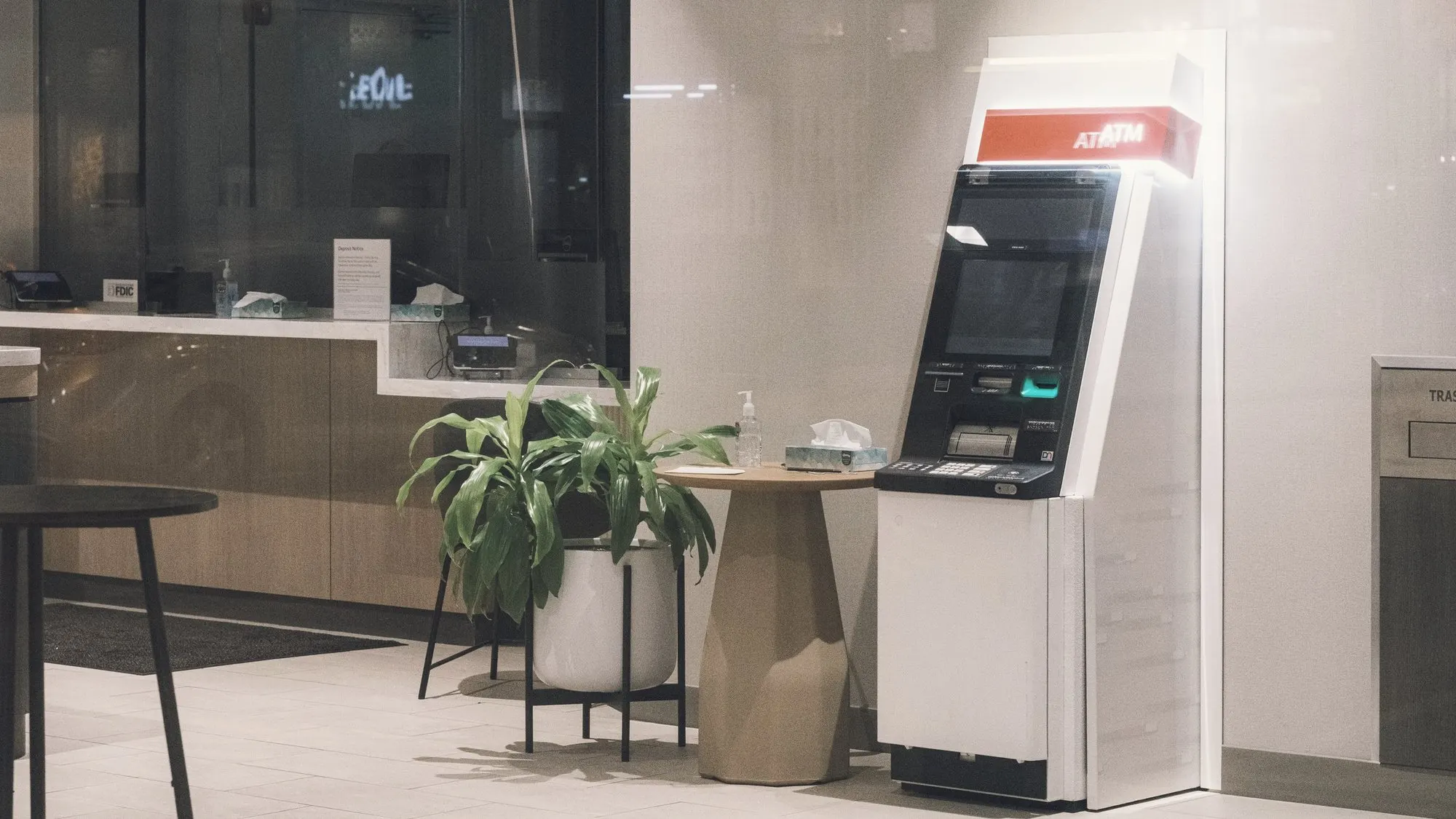
Short answer: a typical freestanding ATM in a store is about 4.5 to 5 feet tall, 16 to 18 inches wide and 2 feet deep, and weighs about 200 to 290 lb. Wall-mount units are smaller, about 27 inches wide and 11 inches deep, at about 126 to 155 lb. Bank-grade and drive-up machines are far bigger, weighing from several hundred pounds to well over a ton.
Every number below comes from the manufacturers’ published specs for current Hyosung and Genmega models (see our ATM catalog for each model’s full spec sheet). If you’re wondering whether an ATM will fit in your business, skip to how much space you need.
ATM size and weight by type
| Type of ATM | Where you see it | Typical size (H × W × D) | Typical weight |
|---|---|---|---|
| Wall-mount | Small shops, salons, counters | About 20–22 × 27 × 11 in | About 126–155 lb |
| Freestanding retail | Bars, stores, restaurants, laundromats | About 55–60 × 16–18 × 22–24 in | About 198–287 lb |
| Through-the-wall | Storefronts, building exteriors | About 35–72 in tall, 15–31 in wide, deep enough to reach a secure room behind the wall | About 145 lb to over 1,800 lb |
| Bank-grade freestanding | Bank branches, busy lobbies | About 51–58 × 16–21 × 25–43 in | About 340 lb to over 1,400 lb |
| Drive-up | Bank drive-throughs | About 54–61 in tall, 28–43 in wide | About 1,600–2,400 lb |
The big jump in weight between retail and bank machines is mostly the safe. A retail ATM has a compact safe built for a single cassette or two. A bank machine has a heavy, high-security safe holding several cassettes, which is also why it can hold far more cash.
Retail ATM dimensions, model by model
These are the machines most businesses get, and the type we place. Published dimensions and weights for current models:
| Model | Type | Size (H × W × D) | Weight |
|---|---|---|---|
| Genmega G2500 | Freestanding | 56.3 × 15.8 × 22.6 in | 197.6 lb (single cassette) |
| Genmega Onyx | Freestanding | 56.3 × 15.8 × 22.2 in | 198 lb (single cassette) |
| Genmega Nova | Freestanding | 60.4 × 15.8 × 22.3 in | 220.2 lb (single cassette) |
| Genmega Onyx-P | Freestanding | 56.3 × 15.8 × 22.2 in | 248 lb (presenter dispenser) |
| Hyosung Halo II | Freestanding | 56.4 × 15.7 × 23.4 in | 265 lb |
| Genmega C6000 | Freestanding | 55.9 × 18.1 × 24.1 in | 271.9 lb (single cassette) |
| Hyosung Force | Freestanding | 56.4 × 15.7 × 23.4 in | 286.6 lb |
| Hyosung MX5200SE | Freestanding | 55.4 × 15.7 × 22.8 in | 287 lb |
| Genmega Onyx-W | Wall-mount | 19.7 × 26.8 × 10.9 in | 125.9 lb |
| Genmega Onyx-W 2K | Wall-mount | 22.4 × 26.8 × 10.9 in | 155 lb |
Two things stand out. First, width barely changes: most freestanding retail ATMs are about 15.7 to 15.8 inches wide (the C6000 is a little wider at 18.1), so the footprint is close to the same whichever model you get. Second, weight varies more than size. Options such as a presenter dispenser or a second cassette add weight without changing the cabinet; Genmega’s G2500P, for example, has the same cabinet as the G2500 but weighs about 243 lb instead of about 198 lb. For a side-by-side look at the two brands, see Hyosung vs. Genmega.
How heavy is an ATM, really?
Heavier than it looks, and on purpose. Weight is part of an ATM’s security: a 200-plus-pound machine anchored to the floor is hard to move. That’s why even the smaller retail models weigh as much as a refrigerator, and the biggest bank and drive-up machines weigh as much as a small car.
For a business owner, the weight matters in three practical ways:
- The delivery path. Steps, raised thresholds and tight turns between the door and the final spot all need planning.
- The floor. A freestanding ATM is anchored to the floor, so it needs a solid surface, not a raised platform or a loose tile floor over a void.
- The wall, for wall units. A 126- to 155-lb wall-mount ATM needs a wall or counter that can carry it, anchored properly.
How much floor space does an ATM need?
Less than most owners expect. A freestanding retail ATM covers roughly 16 × 23 inches, or about 2.5 square feet, about the footprint of a small filing cabinet.
On top of the footprint, plan for:
- Clear space in front so customers can walk up, and someone in a wheelchair can pull up to the screen and keypad.
- A standard outlet within reach. That’s the only utility a placed ATM needs from you; the connectivity is part of the service.
- Visibility. Size is rarely the problem; a hidden corner is. See where to put an ATM in your store for the placement rules that make a machine get used.
If floor space is truly tight, a wall-mount model fits in about 11 inches of depth and leaves the floor clear.
Through-the-wall and drive-up ATMs
These are a different kind of project. A through-the-wall ATM faces the street, while its body and safe sit in a secure room behind the wall, so it needs an opening cut to the manufacturer’s construction guide and a secure space for loading and service. A drive-up ATM sits on its own island or in a drive-through lane and weighs well over half a ton. Both make sense for banks and some large sites; most stores, bars and restaurants are better served by a freestanding or wall-mount machine inside.
Will an ATM fit in your business?
Almost certainly. If you have a few square feet of floor near the entrance or the counter and a standard outlet nearby, a freestanding retail ATM fits. If you don’t, a wall-mount unit usually does.
With BayTM’s free ATM placement, you don’t have to work any of this out yourself. A free location review checks your space, the delivery path, the floor and the power, and we recommend the machine that fits. Installation is usually a single visit, and the machine, cash loading and repairs cost your business nothing. Request a free location review, or read how to get an ATM for your business first.
Frequently asked questions
How big is a typical ATM in a store?
A typical freestanding retail ATM, the kind you see in a bar or convenience store, is about 55 to 60 inches tall, about 16 to 18 inches wide and about 22 to 24 inches deep. For example, Genmega publishes 56.3 × 15.8 × 22.6 inches for the G2500, and Hyosung publishes 56.4 × 15.7 × 23.4 inches for the Halo II.
How much does an ATM weigh?
It depends on the type. Wall-mount retail units weigh about 126 to 155 lb, freestanding retail ATMs about 198 to 287 lb, and bank-grade machines with heavy safes from about 340 lb to over 1,400 lb. Drive-up machines can weigh close to 2,400 lb. Every figure here is the manufacturer's published spec.
How much floor space does an ATM need?
A freestanding retail ATM covers about 2.5 to 3 square feet (roughly 16 by 23 inches). Add clear space in front so customers, including someone in a wheelchair, can walk or roll up to it. In practice a few square feet of floor and a standard outlet nearby are all most businesses need.
Can an ATM go on a wall or a counter?
Yes. Wall-mount models such as the Genmega Onyx-W (about 19.7 × 26.8 × 10.9 inches, 126 lb) and the larger-capacity Onyx-W 2K (22.4 inches tall, 155 lb) are built for tight spaces. They need a wall or counter strong enough to take the weight, anchored properly.
Will an ATM fit through my door?
Almost always. A freestanding retail ATM is only about 16 inches wide, narrower than a standard doorway. The bigger questions are the weight on the delivery path (steps, thresholds, tight turns) and a solid floor to anchor it to, which is what a location review checks.