
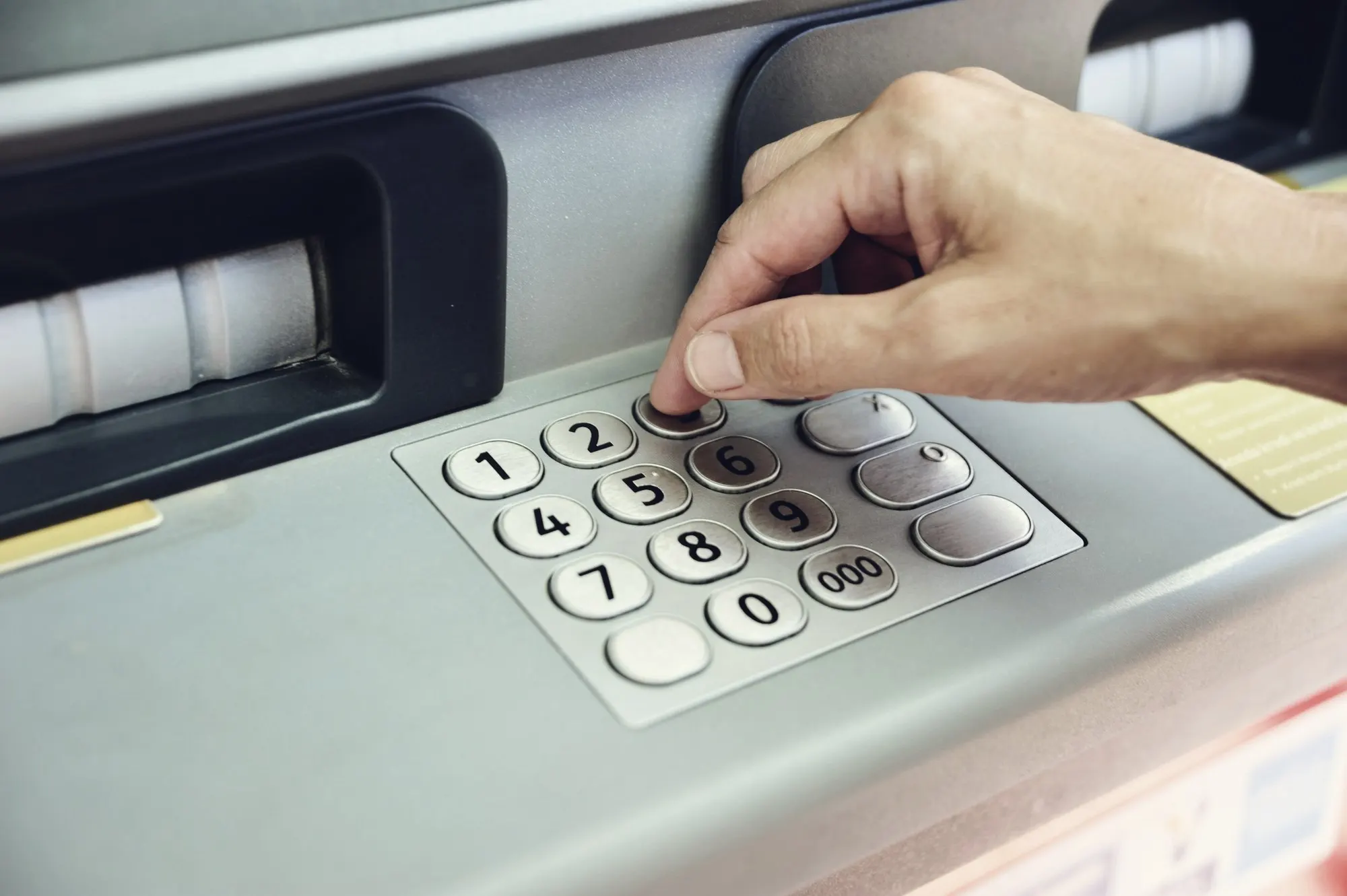
Short answer: an ATM reads your card, asks your bank (through a payment network) whether the withdrawal is allowed, and, if the bank says yes, counts out the cash from a locked cassette inside its safe, then records the transaction. The whole thing takes less than a minute, and the machine never holds your account information itself.
If you own a business, it also helps to know what’s happening behind the screen, because that’s what a placed ATM does for your customers every day. Below: the steps, the parts, where the cash comes from, and what it means for a business that wants an ATM.
What happens when you use an ATM, step by step
| Step | What the customer does | What the machine does |
|---|---|---|
| 1 | Inserts or taps a card | The card reader reads the chip (EMV) or the contactless signal and identifies the card’s network and bank |
| 2 | Enters a PIN | The encrypted PIN pad scrambles the PIN right away, so it never travels in readable form |
| 3 | Chooses an amount | The screen shows the options and, if a convenience fee applies, shows it before the customer confirms |
| 4 | Confirms | The ATM sends an encrypted request through its processor and the card network to the cardholder’s bank |
| 5 | Waits a few seconds | The bank checks the balance and the PIN, and replies with an approval or decline |
| 6 | Takes the cash | The dispenser picks the bills, counts them, checks them with sensors and presents them |
| 7 | Takes the card and receipt | The machine logs the transaction so it can be settled and balanced |
The important point is step 4: the ATM is a messenger, not a bank. It doesn’t know your balance. The approval comes from your bank, which is why an ATM from any company can serve your card, and why the machine needs a live connection to work.
What’s inside an ATM
- Card reader. Reads chip, and often contactless, cards. Modern machines use EMV chip readers.
- Encrypted PIN pad. A tamper-resistant keypad that encrypts the PIN at the moment it’s typed.
- Screen and function buttons. Where the customer picks the amount and sees any fee notice.
- Computer and software. A small computer runs the machine, talks to the network and controls the dispenser.
- Dispenser and sensors. A picker mechanism pulls one bill at a time, and sensors check thickness and count so the right amount comes out and mis-picks are caught.
- Cash cassette(s) and safe. The bills sit in locked cassettes inside a steel safe. This is the heaviest part of the machine, which is why ATMs weigh what they do.
- Receipt printer. Prints the customer’s receipt and the machine’s own reports.
- Modem. Connects to the network over broadband or cellular.
Retail machines from Hyosung and Genmega all follow this same design. Higher-end models add things like a second cassette or a presenter-style dispenser, and our ATM catalog lists each model’s specs.
Where the cash and the network come from
An ATM has two supply lines: money and data.
The cash is loaded into the cassettes by whoever runs the machine. At a bank, that’s the bank or a cash-handling partner. In a business, it’s the ATM company that placed the machine. How much a machine can hold depends on the cassette and the bill denomination; we break down the numbers in how much money does an ATM hold.
The data flows through an ATM processor, the company that connects the machine to the card networks and to each cardholder’s bank. Processing is a separate job from owning or stocking the machine, and it’s why choosing the right partner matters; see how to choose an ATM processor.
Remote monitoring ties the two together. Through the same connection, a machine can report its cash level and any fault to the company that runs it, so a low-cash or error condition gets handled before customers find an out-of-service sign.
Bank ATMs vs. ATMs in a business
The machine in a bar, store or laundromat works the same way as the one outside a bank branch. The differences are about who is behind it:
| Bank ATM | ATM in a business | |
|---|---|---|
| Who runs it | A bank | An ATM company (an independent operator) |
| Who stocks the cash | The bank or its partner | The ATM company |
| Who pays when a customer withdraws | The bank, or the customer’s own bank may charge | The customer sees a convenience fee on screen and confirms it before the withdrawal |
| What the business provides | Nothing; it’s the bank’s property | Floor space and power |
For the business owner, the useful part is that you don’t need to run any of this yourself. The machine, the connection, the cash and the servicing can all be handled by an ATM company.
What this means if you want an ATM in your business
You have two basic routes: buy and run your own ATM, or have a company place one for you. With BayTM’s free ATM placement, the machine, installation, cash loading, connectivity, maintenance and repairs cost your business nothing, there is no monthly fee and no minimum transaction volume. Customers pay a convenience fee that is shown on screen before they confirm. For a closer comparison, read free placement vs. a merchant-owned ATM or how ATM placement works.
To see whether your space fits, request a free location review. We check the spot, the power and the delivery path, recommend a machine, and installation is usually a single visit after the review and agreement. BayTM serves the San Francisco Bay Area and all of California, and places ATMs in every US state.
Frequently asked questions
What is an ATM?
An ATM (automated teller machine) is a self-service machine that lets people withdraw cash and, on some models, check balances using a debit or credit card and a PIN. It is basically a secure cash dispenser connected to a payment network, which lets it check with the cardholder's bank before it hands out any money.
How does an ATM know how much money you have?
It doesn't. The ATM never holds your account balance. It sends your request, encrypted, through a processor and payment network to your bank. Your bank checks the balance and replies with an approval or a decline, and only then does the ATM count out the cash.
How does an ATM get its cash?
Cash is loaded into removable cassettes, locked trays that sit inside the machine's safe. A bank ATM is stocked by the bank or its cash-handling partner. A placed retail ATM is stocked by the ATM company; with BayTM's free placement program, BayTM loads its own cash, so the business doesn't handle ATM cash at all.
Do ATMs have cameras?
Many do. Bank ATMs usually have a camera built into the cabinet, and some sites add their own security cameras nearby. What a given machine has depends on the model and the site.
Does an ATM need an internet connection?
It needs a connection to the payment network, usually broadband or a cellular modem, because every withdrawal has to be approved by the cardholder's bank in real time. The same connection is how the machine can report low cash levels or faults to the company that runs it.
What happens when an ATM runs out of cash?
It stops dispensing, usually shows an out-of-service message, and gets restocked. Remote monitoring is what lets a company see cash running low before that happens. BayTM monitors the machines it places remotely for cash levels and faults.